Medications
GLP-1 and protein: what matters beyond the shake
Protein deserves attention during GLP-1 treatment. Here is what muscle research can tell you, and what a supplement label cannot.

Imagine a hypothetical trip to the supermarket. You're in the protein aisle with a tub in each hand, trying to answer a question that sounded much easier at home: if you're taking a GLP-1 medication, how much attention should you pay to protein?
The labels can tell you what's in the tubs. They can't tell you what your diet needs.
There is a reason to ask. Research on semaglutide and tirzepatide links weight loss with reductions in both fat and lean mass. One small study also linked higher protein intake with better preservation of estimated skeletal muscle mass. That supports a conversation about nutrition; it doesn't establish that a particular shake, or a universal daily target, will protect everyone's muscle. 235
So before choosing between the tubs, it helps to separate three questions: what changed on the scale, what changed in your body, and what you can actually do. Those questions are related. They aren't interchangeable.
The scale leaves out part of the story
A scale gives you one number. The research asks what makes up the change in that number. Reviews of semaglutide and tirzepatide describe substantial fat loss accompanied by smaller reductions in lean mass. But “lean mass” is not another name for skeletal muscle, and a decrease in it does not necessarily mean someone has lost strength or physical function. 23
That distinction matters when a headline says a treatment causes muscle loss. Researchers may be describing a body-composition estimate, while the reader pictures being less able to do everyday things. Those are different outcomes. One review specifically cautions against treating lean-body-mass loss as a direct substitute for skeletal-muscle loss or evidence of drug-related muscle toxicity. 2
The diagram below separates measurements that are easy to collapse into one idea. DXA scans report lean mass; bioelectrical impedance analysis, often shortened to BIA, can estimate fat-free mass; strength and physical performance are separate things to assess. A review discussing these measures explains that the first two are not equivalent to skeletal muscle, and a fall in lean tissue does not necessarily mean worse function. 3
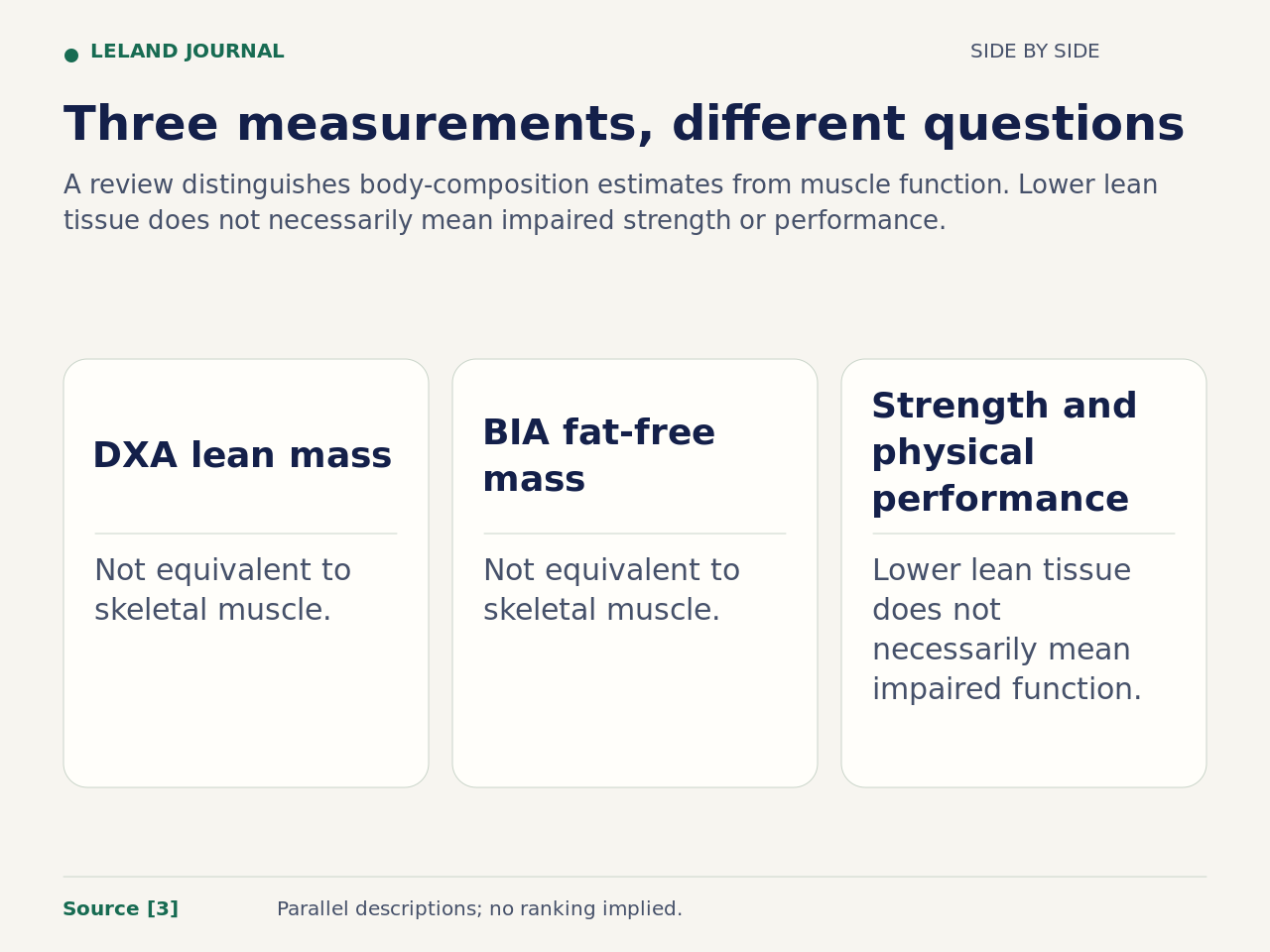
Body composition and muscle function compared. Three measurements, different questions. A review distinguishes body-composition estimates from muscle function. Lower lean tissue does not necessarily mean impaired strength or performance. Parallel comparison: DXA lean mass: Not equivalent to skeletal muscle.; BIA fat-free mass: Not equivalent to skeletal muscle.; Strength and physical performance: Lower lean tissue does not necessarily mean impaired function. Source [3].
The useful question becomes: “What was measured?” That small question can change how you read a very alarming headline.
What the protein finding actually shows
The CRAVE study followed 28 adults starting semaglutide or tirzepatide for 24 weeks. They did not receive a structured nutrition intervention. Researchers recorded food intake and used BIA to assess body composition. Participants lost weight and fat, alongside reductions in estimated skeletal muscle mass. Higher absolute protein intake was associated with greater preservation of that estimated muscle mass. 5
An association is a lead, not a guarantee.
This was a small observational study, and some participants dropped out. It did not randomly assign people to different protein intakes and then establish that protein caused the difference in muscle preservation. The authors describe the results as exploratory: useful for identifying questions that larger studies should test. The finding supports interest in protein adequacy, while leaving the size and reliability of any protective effect unsettled. 5
Broader reviews place adequate protein within a package of care that includes nutrition support, resistance exercise and assessment of muscle function. They do not reduce that package to a supplement. One describes a food-first approach, with protein supplements or nutritionally complete meal replacements potentially useful when intake is insufficient. 23
Back in the hypothetical aisle, that changes the task. Instead of asking which tub promises the most, you can ask what gap, if any, you are trying to fill.
Less food doesn't automatically mean a better diet
Here's another result from CRAVE: diet quality did not significantly improve during treatment, even though calorie intake fell. Intake of macronutrients and several micronutrients also decreased. Food cravings were largely unchanged overall. These findings describe this small group without structured nutrition support; they do not tell us what happens to everyone taking a GLP-1 medication. 5
“Didn't significantly improve” also doesn't mean “got worse.” It means the study did not find a statistically significant improvement in its diet-quality measure. Keeping that distinction intact stops a useful finding from turning into a much bigger claim.
Think about a hypothetical plate of food. Making every portion smaller could lower the total grams of protein while leaving protein's share of the meal unchanged. That's simple portion arithmetic, not evidence that everyone eats that way on medication. It helps explain why a discussion about total intake is different from a discussion about whether the diet is balanced.
A food-first conversation can begin with what you actually eat and whether it is enough. The review's place for supplements is specific: they may help when intake is insufficient. A supplement label, by itself, cannot establish that you have that shortfall or that a particular product will prevent muscle loss. The research supports assessing the need before treating the product as the answer. 3
About that daily protein number
If you're looking for a single target, one number in the research needs especially careful handling. The LEAN-PREP trial protocol describes a planned study of resistance exercise and protein supplementation alongside semaglutide or tirzepatide. Its protein intervention targets 1.6 grams per kilogram of body weight per day. 1
That's a research target. It isn't a result.
The protocol describes plans to enroll 232 adults in Kuwait and compare four groups over six months: control, resistance exercise, protein supplementation, and the two interventions together. Researchers plan to measure thigh-muscle size using MRI, along with strength, physical function and other outcomes. As a protocol, it does not report whether those interventions worked. 1
It therefore cannot tell you that this amount prevents muscle loss, or that everyone taking these medications should adopt it. The more useful question for a clinician or registered dietitian is how to assess your current intake and choose a suitable target. Reviews favor individualized nutritional care; they also acknowledge limited evidence about functional outcomes, including in older or frail people. 12
Keep the medication questions separate
Protein advice doesn't answer whether a medication itself is appropriate. If you encounter compounded semaglutide or tirzepatide, compounded drugs are not FDA-approved, and the FDA does not review them for safety, effectiveness or quality before marketing. The agency says compounded drugs should only be used when a patient's medical needs cannot be met by an FDA-approved drug. 6
The FDA has received reports of adverse events, some requiring hospitalization, potentially related to dosing errors with compounded injectable semaglutide. Separately, it has received adverse-event reports involving compounded semaglutide or tirzepatide prescribed at doses beyond the approved drug labels. Those are distinct reports; the hospitalization statement specifically concerns the semaglutide dosing-error reports. 6
Other FDA concerns include inadequate refrigeration during shipping, fraudulent product labels and semaglutide salt forms. It also recommends discarding multi-dose vials within 28 days of first use, even if medication remains. Questions about the product, its instructions or its storage belong with the prescriber, pharmacist or compounder. They cannot be resolved by adding protein to a diet. 6
Leave with a better question
The two tubs in our hypothetical aisle may still be sitting there. What has changed is the question you're bringing to the decision. Research supports paying attention to nutrition and muscle health during treatment, but the current evidence doesn't establish a shake as the solution or a protein target that fits everyone. Resistance exercise and individualized nutrition support appear alongside protein in the reviews for a reason: the proposed approach has several parts. 23
At your next appointment, try: “Can we look at what I'm eating, whether I'm getting enough protein, and how we'll assess strength and function as my weight changes?” That gives the conversation something concrete to work with before you choose a supplement.
Evidence note: This article uses published abstracts of peer-reviewed studies and reviews, plus FDA guidance. Abstracts leave out details available in full papers. The CRAVE findings are exploratory, and LEAN-PREP is a protocol, not a completed-results report. This is educational information, not personalized medical advice; discuss changes to diet, exercise or medication with your care team.
Sources and evidence
[1] LEAN mass Preservation with Resistance Exercise and Protein during semaglutide and tirzepatide therapy (LEAN-PREP study): a protocol for a randomised controlled trial. https://pubmed.ncbi.nlm.nih.gov/42020128/ (opens in a new tab) Retrieved 2026-11-10. Published 2026-04-22. ↩︎
[2] Beyond Weight Loss: Skeletal Muscle Health During Incretin-Based Therapy in Patients with Diabesity. https://pubmed.ncbi.nlm.nih.gov/42654234/ (opens in a new tab) Retrieved 2026-11-10. Published 2026-08-14. ↩︎
[3] Lean Mass and Musculoskeletal Preservation in GLP-1-Based Obesity Treatment: Nutrition, Exercise, Supplementation, and Monitoring Strategies. https://pubmed.ncbi.nlm.nih.gov/42346344/ (opens in a new tab) Retrieved 2026-11-10. Published 2026-05-27. ↩︎
[4] Complex clinical encounter series: glucagon-like peptide-1 receptor agonists-induced weight loss: are we paying attention to bone health? https://pubmed.ncbi.nlm.nih.gov/41989133/ (opens in a new tab) Retrieved 2026-11-10. Published 2026-08-01.
[5] Changes in food cravings, dietary quality, body composition, and dietary intake during GLP-1 receptor agonist therapy: The CRAVE study. https://pubmed.ncbi.nlm.nih.gov/42440974/ (opens in a new tab) Retrieved 2026-11-10. Published 2026-06-29. ↩︎
[6] FDA concerns with unapproved GLP-1 drugs used for weight loss https://www.fda.gov/drugs/drug-alerts-and-statements/fdas-concerns-unapproved-glp-1-drugs-used-weight-loss (opens in a new tab) Archived copy retrieved 2026-09-06. ↩︎